
Eye Hospital Insurance and Cashless Treatment in Patiala: How to Use Your Cover at Garg Eye Hospital
Garg Eye Hospital in Patiala is empanelled with insurers, TPAs and government schemes, so many patients can plan cataract, glaucoma, retina and squint care through cashless approval. Bring your insurance or scheme card and ID, and the desk checks it against the hospital's cashless list, starts the approval and explains what the policy pays and what you pay. This page explains the whole process, in plain language.
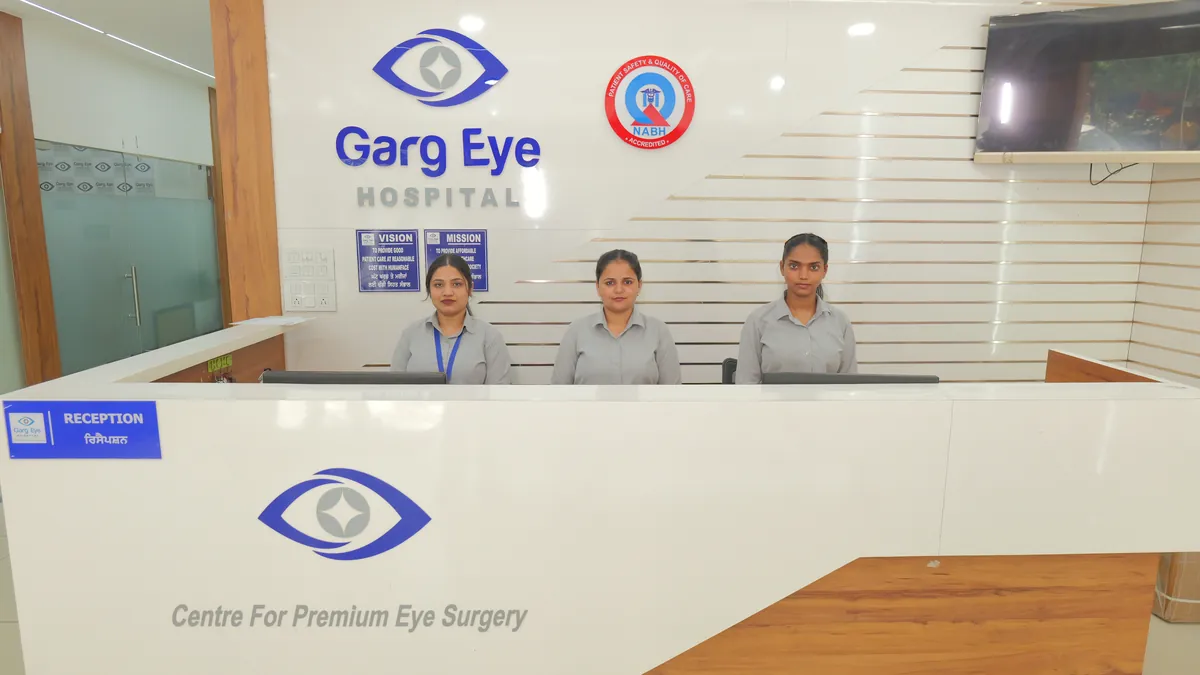
Quick answer
Garg Eye Hospital in Patiala is empanelled with insurers, TPAs and government schemes for cashless eye treatment. Bring your insurance or scheme card, photo ID and doctor's advice to the reception desk, which checks your card against the hospital's cashless list and starts approval. Cataract, glaucoma, retina and squint treatment are commonly claimed. Elective vision correction such as LASIK has limited cover. Call +91 98554-91500, Monday to Saturday, 9 AM to 5 PM.
Which insurers, TPAs and schemes does the hospital work with?
The hospital is empanelled with insurers, TPAs and government schemes. The panel changes over time, because insurers update their networks. The reliable way to find out is to bring your card to the desk. The team checks it against the hospital's current cashless list and tells you the same day.
| Type | Examples that patients usually hold | What to bring |
|---|---|---|
| Private health insurers | Retail health plans and family floater policies | Policy card or e-card, policy number |
| Public sector general insurers | Individual and group mediclaim policies | Policy card and ID |
| TPA cards | Cards issued by a TPA for an insurer or employer | TPA card and photo ID |
| Corporate group cover | Employer provided health insurance | Employee ID, TPA card, HR letter if asked |
| Government health scheme cards | Central and state health coverage cards | Scheme card, Aadhaar or other photo ID, any referral paper |
| Government employee and veteran schemes | Schemes for serving and retired employees and ex-servicemen | Scheme card, ID and referral or permission as the scheme needs |
If your insurer is not on the hospital's list, ask what other options exist. You may still use the policy by reimbursement. See the section below on reimbursement.
How do you use cashless at Garg Eye Hospital, step by step?
- Check your card. Call the desk at +91 98554-91500 with your insurer or scheme name and policy details.
- Book your consultation. Dr. Amandeep Garg, MBBS, DNB, examines you and advises the treatment. Use the booking page or call.
- Share documents. Give the desk your card, photo ID, and any earlier reports.
- Pre-authorisation. The hospital sends the treatment plan and estimate to your insurer or TPA for approval.
- Approval. The insurer approves, queries or declines. The desk keeps you informed.
- Treatment. On the day, you carry your card and ID. Many eye procedures are day care.
- Discharge and settlement. The hospital settles with the insurer. You pay only what is not covered.
- Follow-up. Keep your discharge papers and review dates.
- 1Card checkBring your card and ID to the desk
- 2Doctor adviceDr. Garg examines you and advises treatment
- 3Pre-authorisationThe hospital sends the plan and estimate to the insurer
- 4ApprovalThe insurer approves, queries or declines
- 5TreatmentDay care or admission as planned
- 6SettlementThe hospital settles; you pay only the uncovered part
Planned surgery needs approval in advance, usually a few days before. Plan ahead so that your date is not delayed. In an emergency, the hospital can send the request after admission, and approval timelines are shorter.
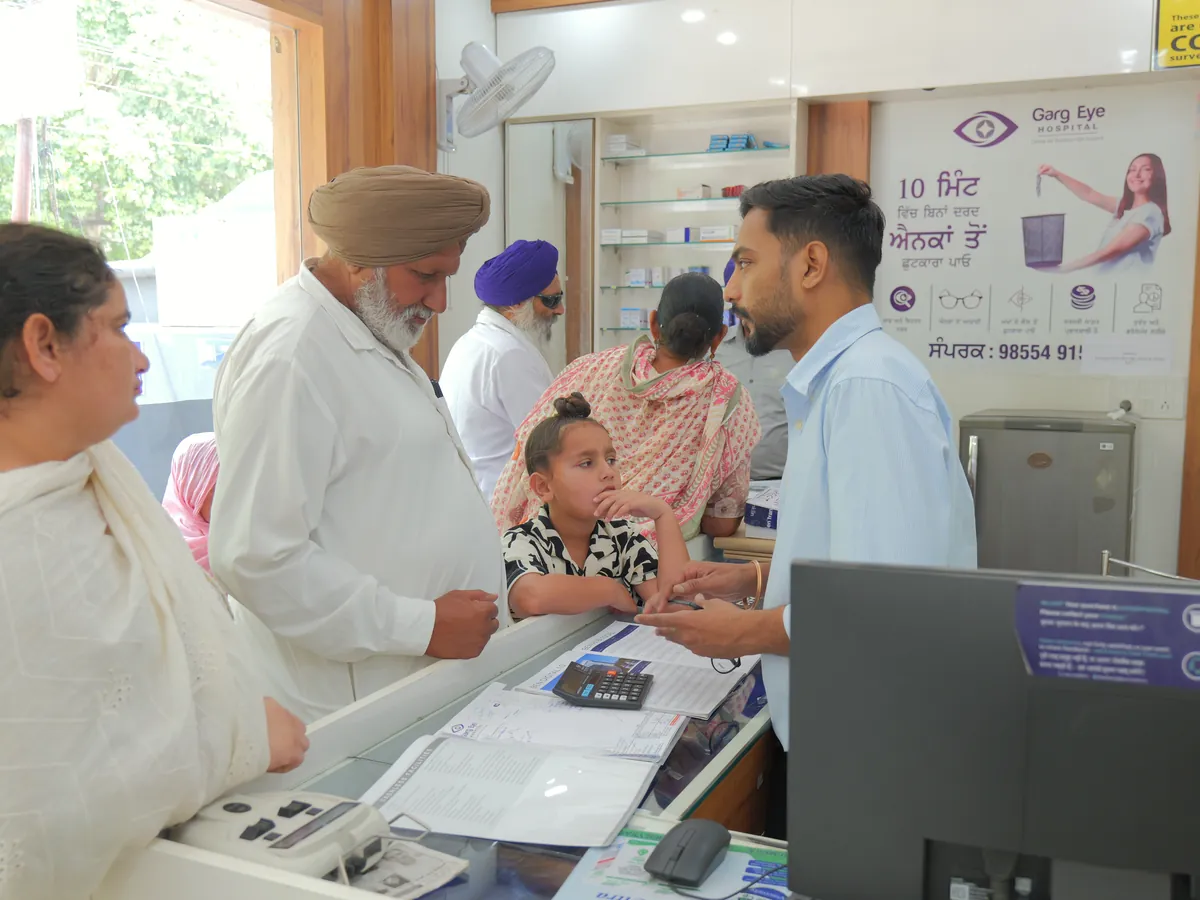
Which documents should you carry?
| Document | Why |
|---|---|
| Insurance or TPA card, or scheme card | To find your policy and check the hospital list |
| Photo ID | To match the name on the policy |
| Policy number and the policyholder's details | For pre-authorisation |
| Doctor's prescription or advice | The medical reason for treatment |
| Earlier eye reports, scans and prescriptions | To support the claim |
| Employee ID or letter, if the cover is from your employer | Some corporate plans ask |
| Referral paper, for government employee or veteran schemes | Needed by some schemes |
| Bank details, for reimbursement claims | For payment to you |
Keep photocopies, and save photos on your phone. A missing document is a common reason for a delay.
Which eye treatments are usually covered by insurance?
Cover depends on your policy, but this table shows the usual pattern for treatments done at the hospital.
| Treatment | Usually covered? | Notes |
|---|---|---|
| Cataract surgery | Commonly yes, after the waiting period | Many policies set a limit per eye, often for a standard lens |
| Premium lens upgrade | Usually only the standard lens amount | You pay the difference for a toric, multifocal or EDOF lens |
| Glaucoma surgery | Commonly yes when medically needed | Drops and routine check-ups are often not covered |
| Retina surgery and some injections | Commonly yes when medically needed | Some policies limit injections |
| Diabetic eye treatment | Commonly yes when medically needed | Screening may not be covered |
| Squint surgery | Often yes when medically needed. Cosmetic cases may be excluded | Ask your insurer for your policy's rule |
| Eye injury and emergency care | Commonly yes | Accident cover may apply |
| LASIK and ICL | Limited. Often treated as elective | Some policies pay if power is above a limit, and some corporate plans reimburse |
| Eyeglasses and contact lenses | Usually not covered | Some plans pay a small yearly eye care benefit |
| OPD consultation and tests | Often not covered | Some plans have an OPD benefit |
These are general patterns, not promises. Your policy wording, sub-limits and waiting periods decide.
How does insurance work for cataract surgery?
Cataract surgery is a day care procedure, so most health policies cover it once the waiting period is over. Policies differ in three areas.
- Waiting period. Cataract can have its own waiting period, from none to several years, depending on the policy and how long you have held it.
- Limit per eye. Some policies cap the amount for each eye, or for the lens. This can be a fixed amount or a share of the sum insured.
- Lens type. Most pay for a standard monofocal lens. A toric, multifocal or EDOF lens costs more, and you pay the difference.
If your policy has a limit, ask the desk to explain how the estimate compares with it. For prices, see cataract surgery cost in Patiala, and for the surgery, see cataract surgery in Patiala. If you are unsure whether you need surgery, read cataract treatment in Patiala.
Does insurance cover both eyes?
Usually each eye is treated as a separate procedure, often a few days to weeks apart. Each is claimed separately, and each may fall under the same sum insured and sub-limit. Ask whether the limit applies per eye or per policy year.
Does insurance pay for glasses after cataract surgery?
Usually not. Most policies exclude glasses. Plan a small budget, and see the in-house optical shop at your review.
How does insurance work for LASIK and ICL?
Policies often treat vision correction for power as a cosmetic or elective choice, so they exclude it. Some policies cover it if power is above a stated limit, and some corporate plans reimburse a part. If you plan LASIK or ICL, read your policy wording and ask your insurer in writing. See LASIK surgery cost in Patiala, ICL surgery in Patiala and specs removal surgery in Patiala for the choices.
How does insurance work for glaucoma, retina and diabetic eye care?
Glaucoma surgery, retina surgery and some injections are generally covered when they are medically necessary. Drops, regular check-ups, scans and screening may not be covered, unless your plan has an OPD benefit. If your doctor advises treatment, ask the desk to include the medical reason and the scans in the claim papers. See glaucoma treatment in Patiala, retina treatment in Patiala and diabetic eye disease in Patiala.
How does insurance work for squint surgery?
Squint surgery that corrects a functional problem, such as double vision, loss of binocular sight or the risk of lazy eye, is often covered. Surgery done only for appearance can be excluded by some policies. Policies differ, so ask your insurer for the written rule, and ask the doctor to state the medical reason. See squint and lazy eye treatment in Patiala.
Which government schemes can be used for eye treatment?
Government schemes fund eye surgery for eligible people, and cataract surgery is a common benefit. The rules differ by scheme and state, and they are updated from time to time. In general:
| Scheme type | What it covers | What to bring |
|---|---|---|
| National and state health protection scheme cards | Hospital treatment for eligible families, up to the scheme limit | The scheme card, ID and any referral paper |
| Government employee schemes | Treatment for serving and retired employees and their families | The scheme card, ID, and permission or referral if needed |
| Ex-servicemen schemes | Treatment for veterans and dependants | The scheme card, ID and referral |
| Insurance schemes for workers | Treatment for insured workers | The scheme card and ID |
The hospital is empanelled with government schemes. Bring your card, and the desk checks your eligibility, the package and what the scheme covers for your treatment. If a premium lens is your choice, the scheme usually pays for the standard package, and you pay the difference.
Ayushman card se eye operation ho sakta hai kya?
हाँ, पात्र मरीज़ अपना कार्ड और पहचान पत्र लेकर रिसेप्शन पर जाँच करवा सकते हैं। रिसेप्शन आपका कार्ड अस्पताल की कैशलेस सूची से मिलाकर बताता है कि कौन सा इलाज और कितना खर्च कवर होगा।
What does cashless not cover?
Even in a cashless claim, some items fall outside the policy. Knowing them in advance avoids surprises.
| Item | Usually paid by you |
|---|---|
| Non-payable items listed by your insurer | Yes |
| Co-payment share | Yes |
| Amount above the sum insured or sub-limit | Yes |
| Premium lens upgrade | The difference above the standard lens |
| Glasses and contact lenses | Yes |
| OPD visits and tests not covered by the plan | Yes |
| Treatments excluded by the policy | Yes |
| Care before the waiting period ends | Yes |
Ask the desk for a written estimate that shows what the insurer is expected to pay and what you pay.
Why do insurance claims get rejected or delayed, and how do you avoid it?
| Reason | How to avoid it |
|---|---|
| Waiting period has not ended | Check your policy start date and waiting periods before planning |
| Treatment excluded in the policy | Read the exclusions list. Ask your insurer in writing |
| Missing documents | Carry the card, ID, reports and prescription |
| Name mismatch between ID and policy | Use the same name and details |
| Pre-existing condition not declared | Always declare conditions when buying a policy |
| Treatment not medically necessary in the insurer's view | The doctor states the reason clearly. Keep reports and scans |
| Sum insured used up | Check your remaining balance |
| Late intimation | Start the request early for planned surgery |
| Hospital not in the network | Ask the desk before booking |
If a cashless request is declined, you can still pay and claim reimbursement, or appeal to the insurer with extra reports. Ask the desk for the papers you need.
What if cashless is not available? How does reimbursement work?
If your insurer does not have the hospital in its network, or your claim is declined for cashless, you can pay the bill and claim the amount from the insurer afterwards. For this, keep these.
- The final bill and payment receipts.
- The discharge summary and the doctor's treatment papers.
- All investigation reports.
- The claim form from your insurer.
- Your ID and bank details.
Submit the papers within the time your insurer allows. The hospital's desk can give you the documents it issues. Reimbursement can take weeks.
What should senior citizens and families know about insurance and eye surgery?
Seniors often have a cataract and are on a family floater, a senior citizen policy or a scheme. A few tips:
- Check the cataract waiting period and limit in your policy.
- Ask whether your policy has co-payment for senior citizens.
- Plan both eyes, and ask how the sum insured is used.
- Bring a family member who knows the policy details.
- Ask for the estimate in writing, including the lens type.
- Keep your reports, since a cataract claim needs the doctor's advice and tests.
What does the cost of eye treatment look like without insurance?
Planning figures from public listings for Patiala, read on 27 November 2026, are shown below. They are not a price list for Garg Eye Hospital. Your own cost depends on the treatment, the lens and the tests.
| Treatment | Approximate price |
|---|---|
| Cataract surgery, standard lens | About ₹30,000 to ₹55,000 per eye |
| Cataract surgery, premium lens | About ₹60,000 to ₹1,10,000 per eye |
| Femto LASIK | About ₹80,000 to ₹1,20,000 for both eyes |
| ICL | About ₹50,000 to ₹80,000 per eye |
| Glaucoma surgery | From about ₹35,000 |
| Retina procedures | From a few thousand rupees for laser to tens of thousands for surgery |
See the detail in cataract surgery cost in Patiala and LASIK surgery cost in Patiala.
How long does the whole cashless process take?
Timing depends on the insurer, the treatment and how complete your papers are. This is a planning guide, not a promise.
| Stage | Usual planning window |
|---|---|
| Card check at the desk | The same day, often on the phone |
| Consultation and advice by Dr. Garg | The day of your visit |
| Pre-authorisation request sent | The same or next working day |
| Insurer response | Often a few days for planned surgery |
| Query from the insurer, if any | Add a few more days while reports are sent |
| Surgery date | Fixed after approval |
| Final settlement between hospital and insurer | Handled by the hospital after discharge |
If you work or travel from a nearby town, ask the desk to share updates by phone, so that you come only once approval is in place.
What happens on the day of surgery for an insured patient?
- Reach the hospital at the time given and go to the desk first.
- Show your insurance or scheme card and photo ID.
- The desk matches them to the approval already received.
- You sign the consent and claim forms the insurer needs.
- You go through the pre-operative steps with the nursing team.
- Dr. Garg performs the procedure. Cataract surgery is usually a day care procedure.
- After rest and a check, you receive your medicines, eye shield and instructions.
- The desk gives you discharge papers and settles the bill for the uncovered part, if any.
- You note your review dates. Keep all papers, in case the insurer asks later.
Cashless eye treatment in Patiala: what people here ask
Searches include eye hospital cashless in Patiala, cataract surgery cashless, Ayushman card for eye treatment, whether insurance covers cataract or LASIK, and mediclaim for eye surgery. The answers follow.
Eye hospital cashless in Patiala
Garg Eye Hospital, Passey Road, near Gurudwara Dukh Niwaran Sahib, is empanelled with insurance companies, TPAs and government schemes. Call the desk with your insurer or scheme name before the day of surgery so the paperwork starts early.
Cataract surgery cashless
Cataract surgery is one of the treatments most commonly covered by health insurance and government schemes, when it is medically needed. Premium lens upgrades are often not covered in full, and the difference is paid by the patient.
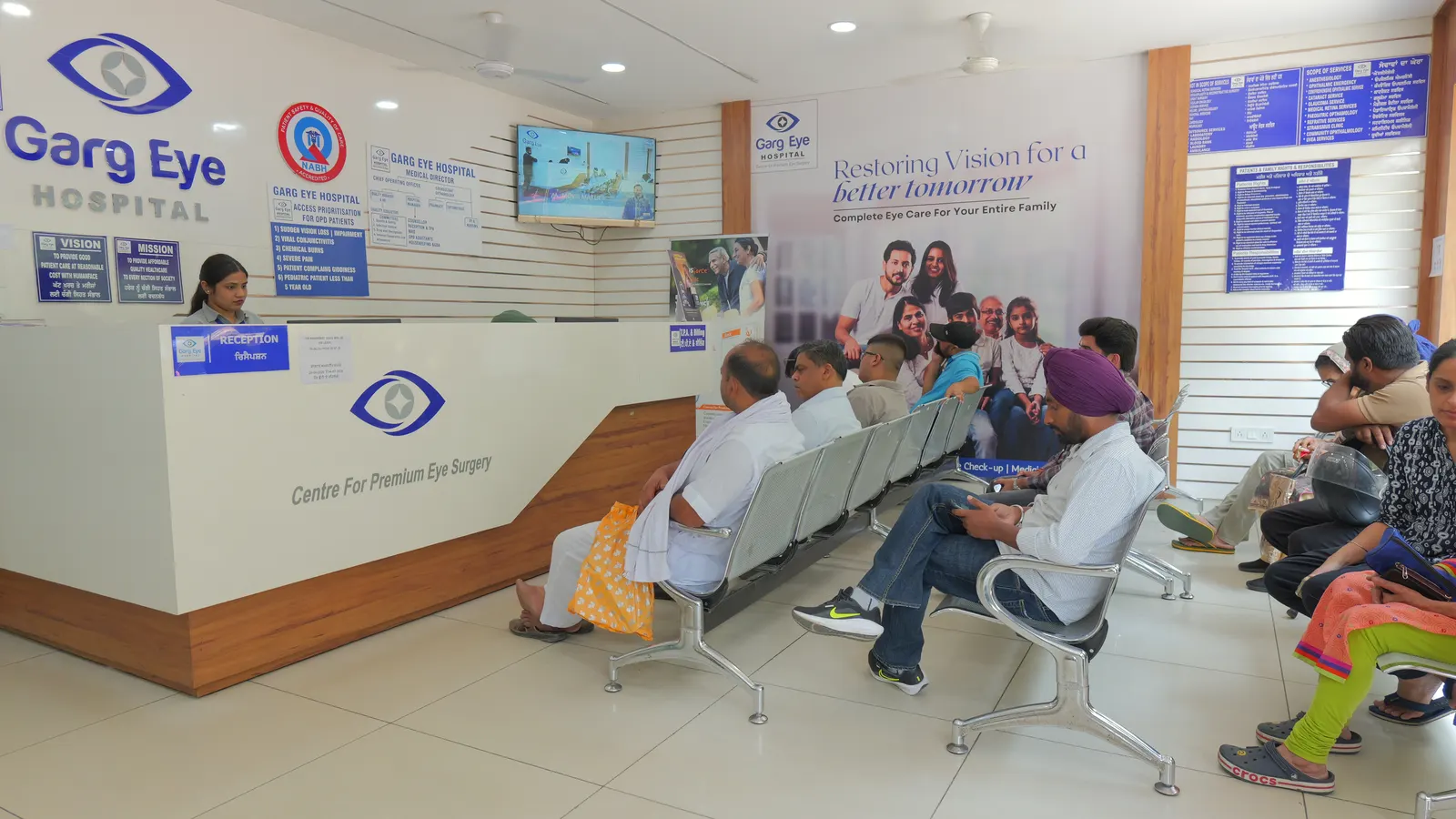
Ayushman card and eye treatment
If you hold an Ayushman card or another government scheme card, bring it with your Aadhaar and the referral or ID papers your scheme needs. The desk tells you the steps for your scheme.
LASIK and ICL with insurance
LASIK and ICL are usually treated as elective vision correction, so policies often exclude or limit them. Read the refractive error clause in your policy.
What to carry on the day
Your policy or card number, photo ID, earlier eye reports, and a family member. Keep the claim and discharge papers safely after surgery.
Garg Eye Hospital on Passey Road, Patiala: how to reach us for cashless eye treatment
Garg Eye Hospital is on Passey Road, Patiala, Punjab 147001, near Gurudwara Dukh Niwaran Sahib. On Google Maps the pin sits close to the Sikh Museum, on the Passey Road and Sirhind Road side of the city. Ask for Garg Eye Hospital near Dukhniwaran Sahib and anyone nearby can point you to it.
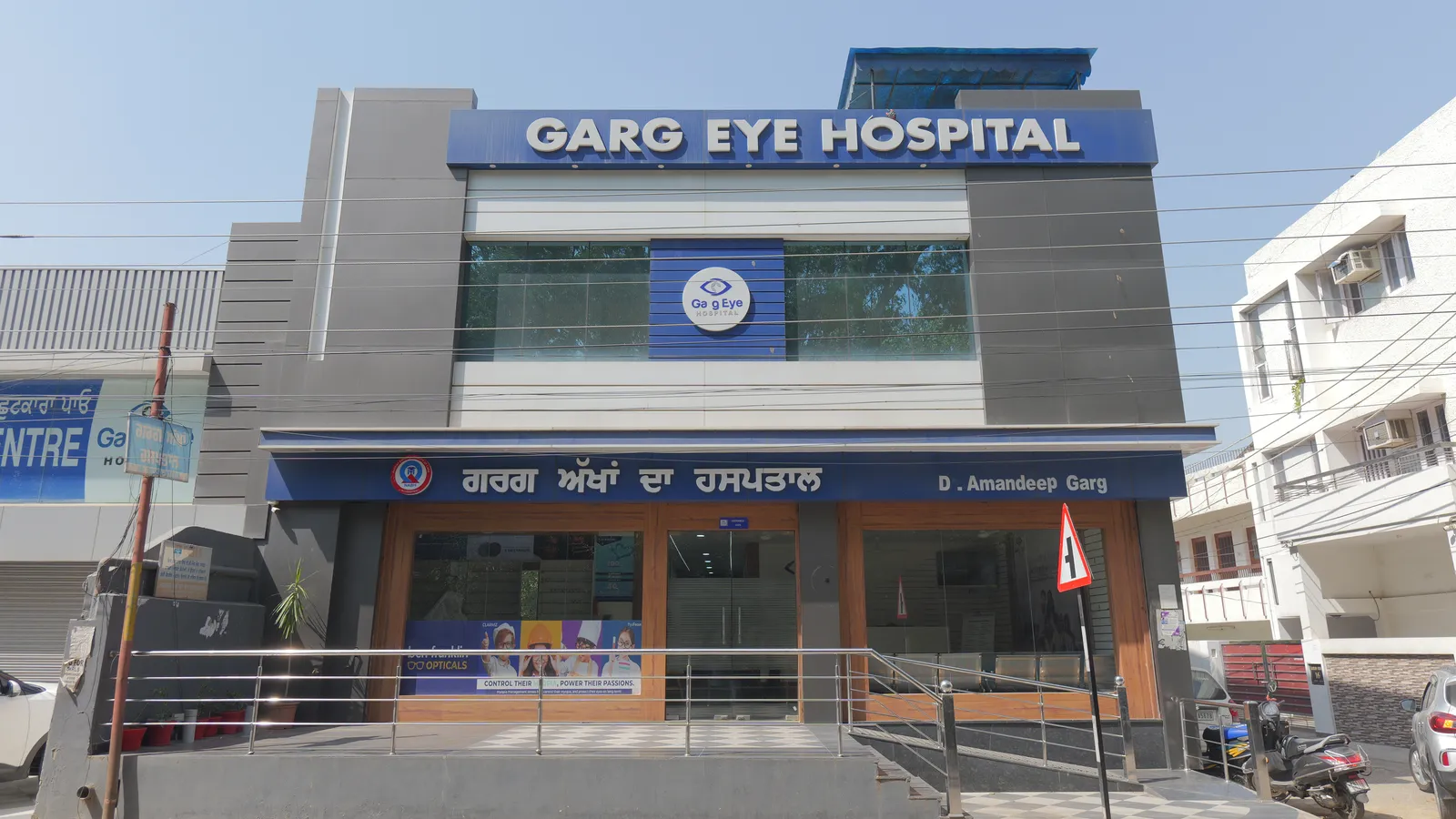
Coming from the bus stand, Leela Bhawan, Urban Estate, Tripuri, Bhadson Road or SST Nagar
Open the hospital pin on Google Maps and follow the route, or call +91 98554-91500 and the desk will guide you. OPD runs Monday to Saturday, 9 AM to 5 PM. Mornings are quieter, so a visit that starts at 9 or 10 AM usually finishes sooner.
Coming from Punjabi University, Thapar University or the Sheran Wala Gate side
Students and staff from this side of Patiala usually come between classes. Tell the desk your timetable when you book and the visit can be planned around it.
Coming from Nabha, Rajpura, Samana, Sirhind-Fatehgarh Sahib, Sangrur, Malerkotla or Khanna
Patients travel from these towns for eye care. See the pages for Nabha, Rajpura, Samana, Sirhind, Sangrur, Malerkotla and Khanna. Bring one family member, because eye drops can blur vision for a few hours after tests.
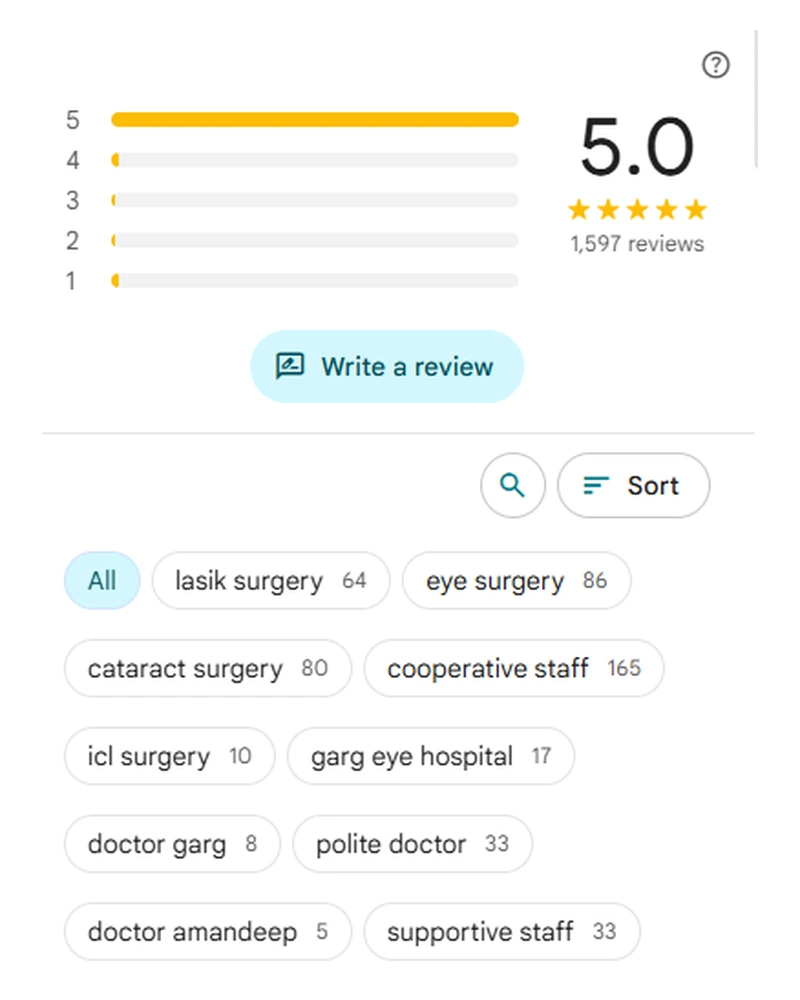
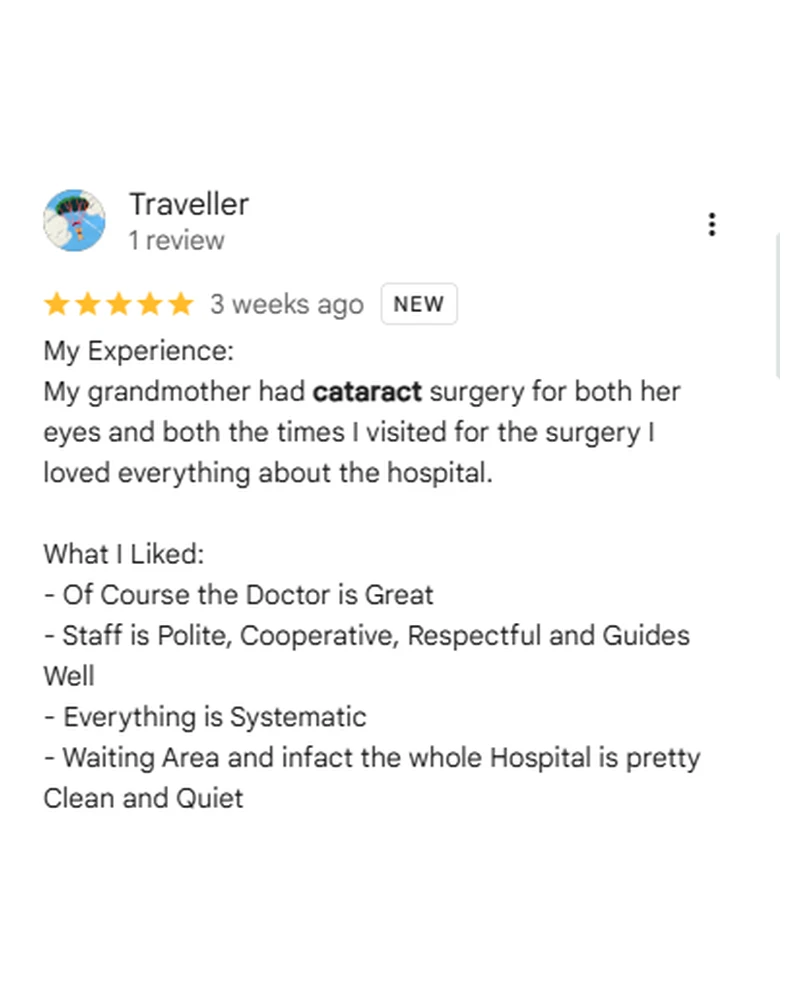
What patients wrote on Google about Garg Eye Hospital, Patiala
The Google listing of Garg Eye Hospital, Patiala, shows a 5.0 rating from 1,597 reviews (1,566 five star, read on 27 November 2026). These are screenshots of public reviews, shown as they appear.
Frequently asked questions about eye insurance and cashless treatment in Patiala
Is cashless eye treatment available in Patiala?
Garg Eye Hospital, Passey Road, is empanelled with insurance companies, TPAs and government schemes. Call +91 98554-91500 with your insurer or scheme name.
Is cataract surgery covered by insurance?
Usually yes, when it is medically needed, subject to your policy terms. Premium lenses are often only partly covered.
How does cashless cataract surgery work?
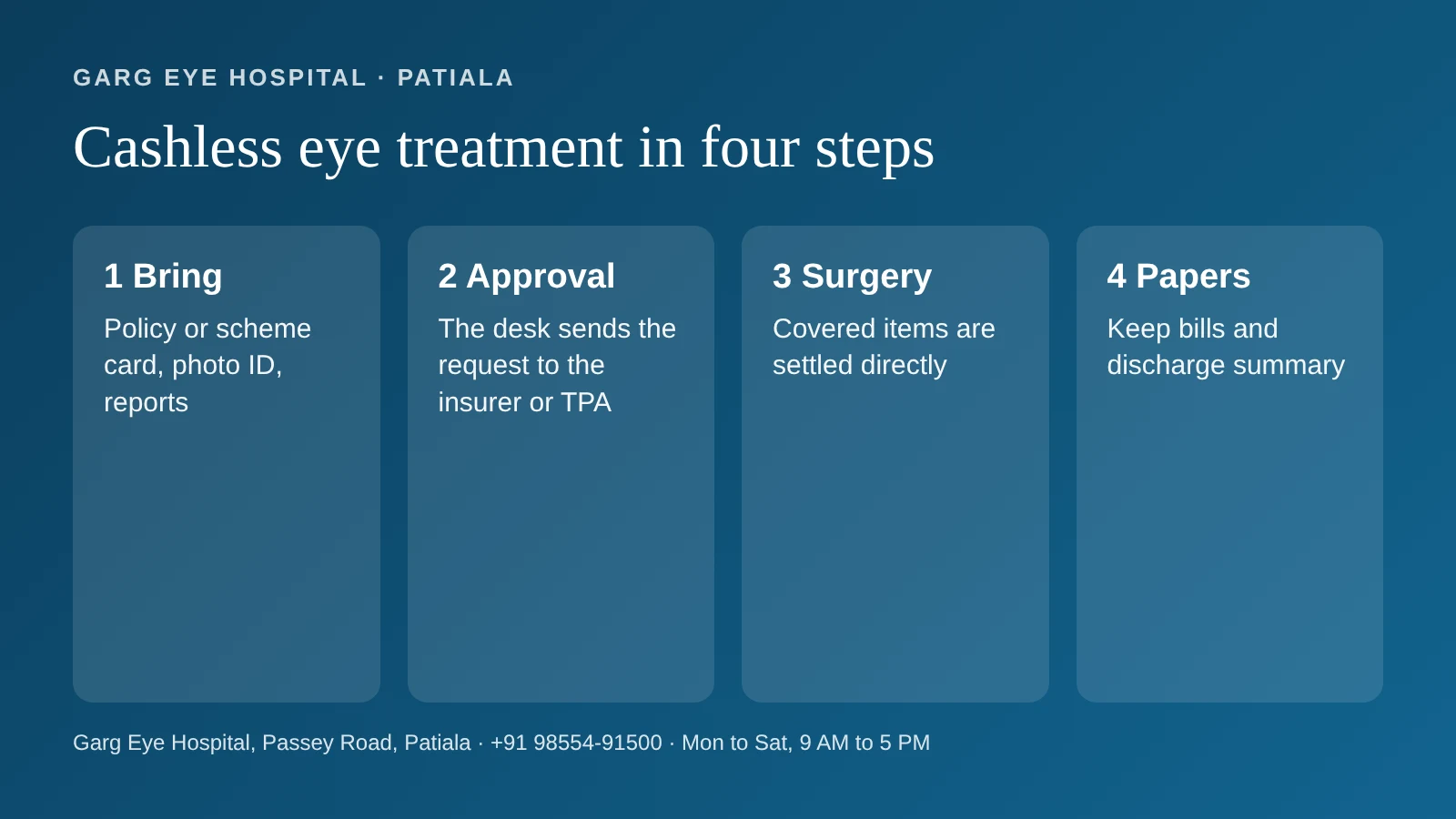
You show your card and ID, the hospital sends the approval request to the insurer or TPA, and after approval the covered amount is settled directly. You pay only the items not covered.
Does the Ayushman card cover eye treatment?
Government scheme cover for eye procedures depends on the scheme and the package. Bring the card and ID, and the desk will guide you.
Does Sehat card work for eye treatment in Punjab?
Scheme rules differ by package. Bring your card and ID to the desk and ask for your treatment.
Is LASIK covered by insurance?
Usually not, because it is elective vision correction. Some policies pay a part when the power is above a set level.
Is ICL covered by insurance?
Same as LASIK, mostly elective. Check your policy.
Does mediclaim cover eye surgery?
Mediclaim commonly covers cataract, retina and glaucoma surgery when medically needed. Cosmetic and elective procedures are usually excluded.
Which documents are needed for a cashless claim?
Policy or card, photo ID, the doctor's advice and earlier reports.
Why do insurance claims get rejected?
Common reasons are waiting periods, procedures excluded in the policy, missing documents or treatment that was not medically needed.
What if cashless is not approved?
You can pay and claim a reimbursement from the insurer. Keep the bills, reports and discharge summary.
How long does cashless approval take?
It varies by insurer. Ask the desk to start the request as early as possible.
Can I use insurance for glasses or medicines?
Usually no for routine glasses. Medicines used for a covered treatment may be included. Ask the desk.
Bima se aankh ka operation: cashless kaise hota hai?
Policy ya card, ID aur doctor ki salah ke saath desk par aayein. Hospital insurer ko approval ke liye bhejta hai. Call: +91 98554-91500.
Contact Garg Eye Hospital, Patiala
Passey Road, Near Gurudwara Dukh Niwaran Sahib, Patiala, Punjab 147001
Phone: +91 98554-91500
Email: gargeyehosp@gmail.com
OPD: Monday to Saturday, 9 AM to 5 PM
Open the map