
Specs Removal Surgery in Patiala: LASIK, ICL and Who Suits Which
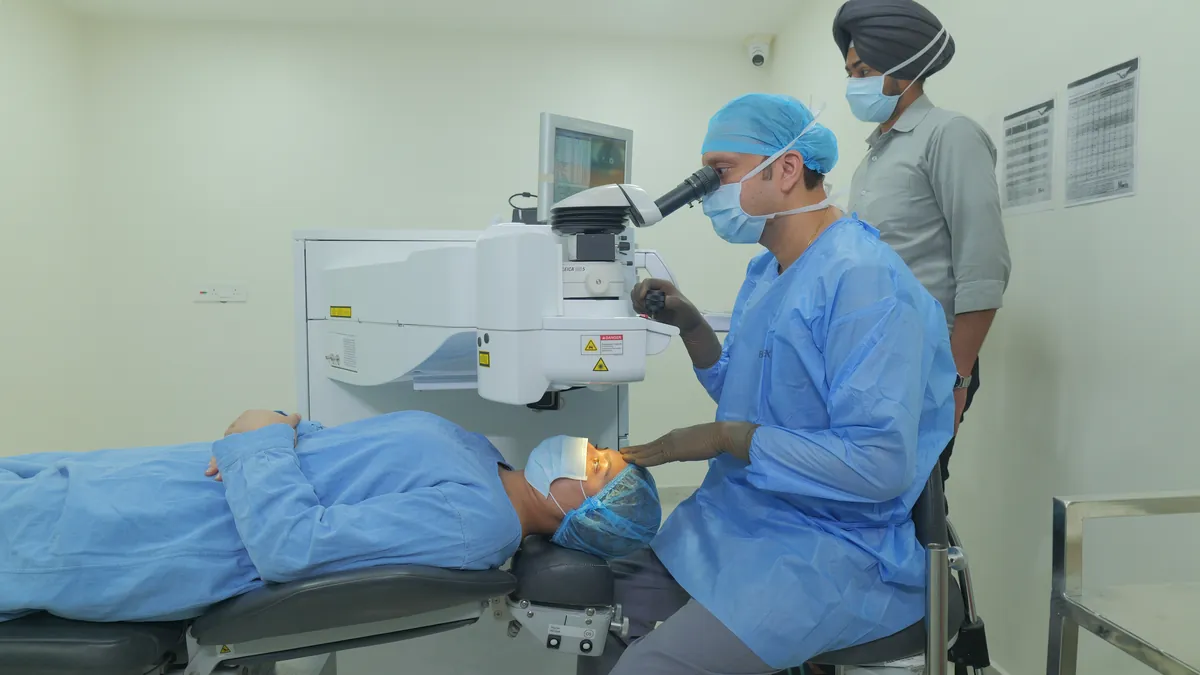
Specs removal surgery at Garg Eye Hospital in Patiala means one of two proven routes. Femto LASIK reshapes the cornea with lasers, and ICL places a thin lens inside the eye. Dr. Amandeep Garg, MBBS, DNB, examines you, maps your cornea and tells you which route suits your eyes, or whether you should wait or keep your glasses.
Quick answer
Specs removal surgery in Patiala is done with Femto LASIK or ICL at Garg Eye Hospital. Dr. Amandeep Garg, MBBS, DNB, is the only surgeon. LASIK suits most healthy corneas with stable power. ICL suits very high power, thin corneas or dry eyes. A corneal map decides the route. Both take about 15 to 30 minutes, and most people return to desk work in a day or two. Call +91 98554-91500, Monday to Saturday, 9 AM to 5 PM.
What is specs removal surgery?
"Specs removal" is the everyday name for vision correction surgery. It is a procedure that lets your eye focus light on the retina without glasses or contact lenses. Doctors call it refractive surgery. Patients in Patiala also search for it as "chashma hatane ka operation", "number hatana", "laser surgery for glasses" or "eye power removal".
Your glasses power exists because the eye does not focus light exactly on the retina. This can happen in three ways.
| Problem | What is happening | What you notice |
|---|---|---|
| Short sight (myopia) | The eye is too long or the cornea too steep, so light focuses in front of the retina | Distant things look blurred. Near reading is clear |
| Long sight (hyperopia) | The eye is too short or the cornea too flat, so light focuses behind the retina | Strain when reading, headaches, blur at near and sometimes at distance |
| Astigmatism (cylinder) | The cornea is shaped more like a rugby ball than a football | Blur and ghosting at all distances, glare at night |
Specs removal surgery changes the focus of the eye. It does not give you a new eye, and it does not stop age-related change. Most people need reading glasses after their early forties, whether or not they have had surgery.
Which specs removal options does Garg Eye Hospital offer?
The hospital offers three routes that remove or reduce the need for glasses. Which one is right depends on your age, your power and your eye tests.
| Option | How it works | Usually suits |
|---|---|---|
| Femto LASIK | A femtosecond laser makes a thin corneal flap without a blade, and an excimer laser reshapes the cornea underneath | Adults with stable power, healthy and thick enough corneas, and moderate power |
| ICL (implantable collamer lens) | A soft, foldable lens is placed inside the eye, in front of your natural lens, through a tiny opening. No corneal tissue is removed | Very high power, thin corneas, dry eyes, or people unsuitable for laser |
| Cataract surgery with an IOL | The clouded natural lens is replaced with an artificial lens, which can correct power too | Adults who already have a cataract, usually from the mid forties or later |
Each route has its own page. Read LASIK eye surgery in Patiala, ICL surgery in Patiala and cataract surgery in Patiala for the full detail. Costs for each are explained in LASIK surgery cost in Patiala and cataract surgery cost in Patiala.
Other centres may advertise additional techniques. This page covers the procedures that Garg Eye Hospital lists, because a plan should be based on what the team can actually do for you.
Who is the surgeon?
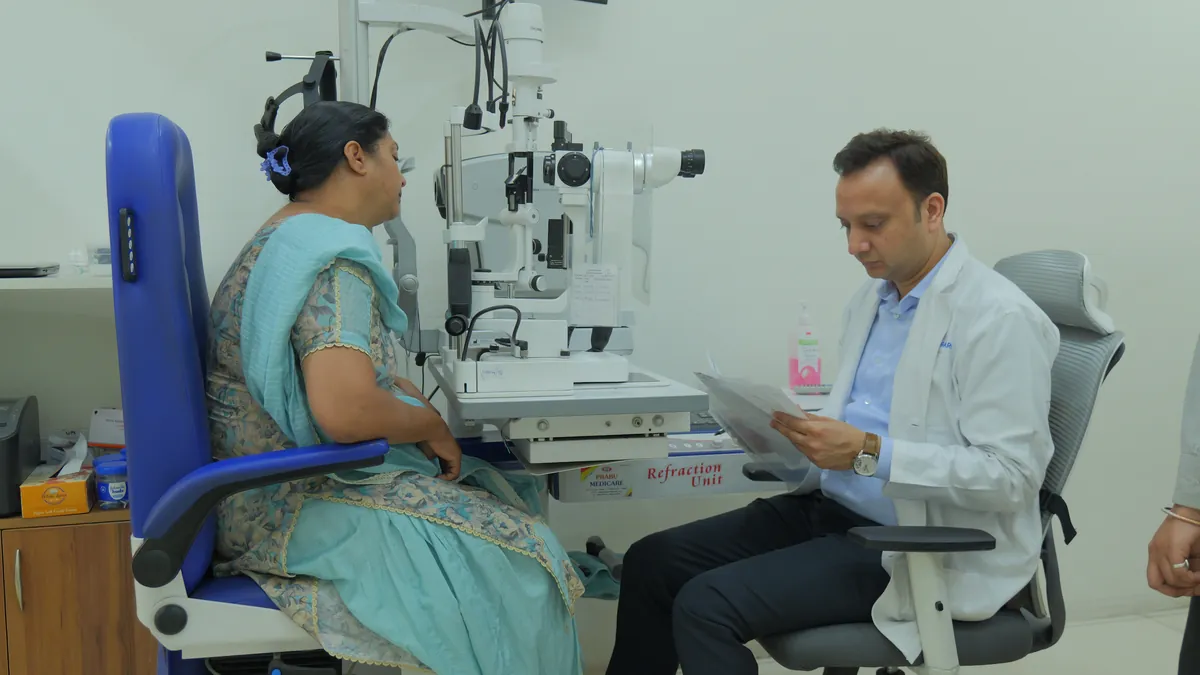
Dr. Amandeep Garg, MBBS, DNB, is the only surgeon at Garg Eye Hospital. He is a phaco and LASIK surgeon. His background includes an association with Sir Ganga Ram Hospital, Delhi, and a consultant role at Manipal (Columbia Asia) Hospital, Patiala. He examines you, reads your maps, advises the route and operates. Read more on the eye specialist page.
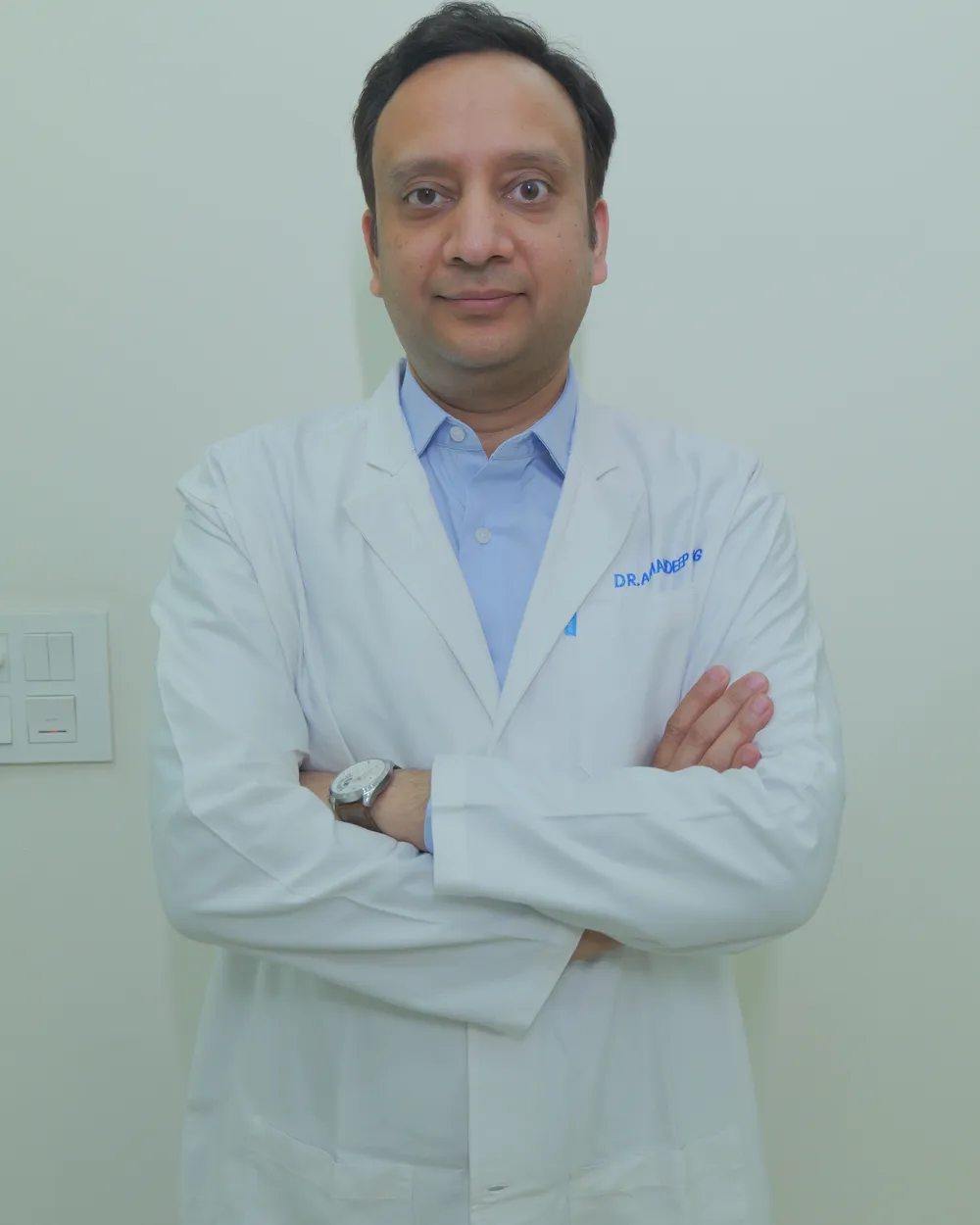
Dr. Amandeep Garg
MBBS, DNB, Phaco and LASIK Surgeon
Dr. Amandeep Garg specialises in cataract surgery and laser vision correction. His background includes an association with Sir Ganga Ram Hospital, Delhi, and a consultant role at Manipal (Columbia Asia) Hospital, Patiala. His approach is careful examination, clear communication and a suitable treatment option for each patient.
LASIK or ICL: how do you choose?
Most patients want a simple answer. The honest answer is that your eyes choose, not your preference. This table shows the points the surgeon weighs.
| Point | Points toward LASIK | Points toward ICL |
|---|---|---|
| Power | Low to moderate short sight, long sight or astigmatism | Very high short sight, or a power outside the usual laser range |
| Corneal thickness | Enough thickness left after the laser | Thin cornea that cannot spare tissue |
| Corneal shape | Regular, healthy shape | Borderline shape, with no sign of disease |
| Dry eye | Mild or none | Dry eye that could worsen after laser |
| Age | 18 to about 45 | Roughly 21 to 45, depending on the eye |
| Anterior chamber depth | Not a factor | Must be deep enough for the lens |
| Reversibility | The cornea is permanently reshaped | The lens can be removed or exchanged by a surgeon |
| Cost | Usually lower | Usually higher |
| Recovery | Very quick | Quick, with a few more checks |
If you are suitable for both, the surgeon discusses the trade-offs with you. Many patients choose LASIK for its lower cost. Others choose ICL when their power is high, because it avoids removing corneal tissue.
What age is right for specs removal surgery?
| Age | What to know |
|---|---|
| Under 18 | Not advised. The eye is still changing |
| 18 to 20 | Possible if your power has been stable for at least one year. Many surgeons prefer to wait until the early twenties |
| 21 to 40 | The ideal window for most people |
| 40 to 45 | Possible. You may need reading glasses soon after, because of age-related near vision changes |
| 45 and above | A lens-based option may suit better, especially if a cataract is starting. Ask at your examination |
| 60 and above | LASIK is not usual. Cataract surgery with a suitable lens may reduce glasses |
There is no single upper limit. Eye health decides, not the number of years. A stable power for about a year, a healthy cornea and a healthy retina matter more than your birth date.
Can an 18-year-old have specs removal surgery?
Only if your power has not changed for about a year and the examination is clear. Many young adults find their power still shifts until their early twenties. A repeat test after six to twelve months is the safe choice.
Is there a maximum age?
LASIK is rarely planned after the late forties or fifties, because cataracts and age-related near vision changes begin. A person aged 60 or 70 may be a good candidate for cataract surgery with a lens that lowers dependence on glasses. This is decided after an examination.
What power range can be treated?
The ranges below are general guides used by surgeons. Your own limits depend on corneal thickness, shape and other tests.
| Type | Typical LASIK range | When ICL is considered |
|---|---|---|
| Short sight | Low to moderate, often up to about minus 8 to minus 10 | Very high short sight, beyond what the cornea can safely allow |
| Long sight | Low to moderate, often up to about plus 4 | Selected cases |
| Astigmatism | Often up to about 5 to 6 cylinder | Toric ICL for suitable eyes |
These figures are indicative. A person with minus 12 and thick, healthy corneas is judged on maps, not on a single number. A person with minus 4 and a thin cornea may need a different plan.
What tests decide your route?
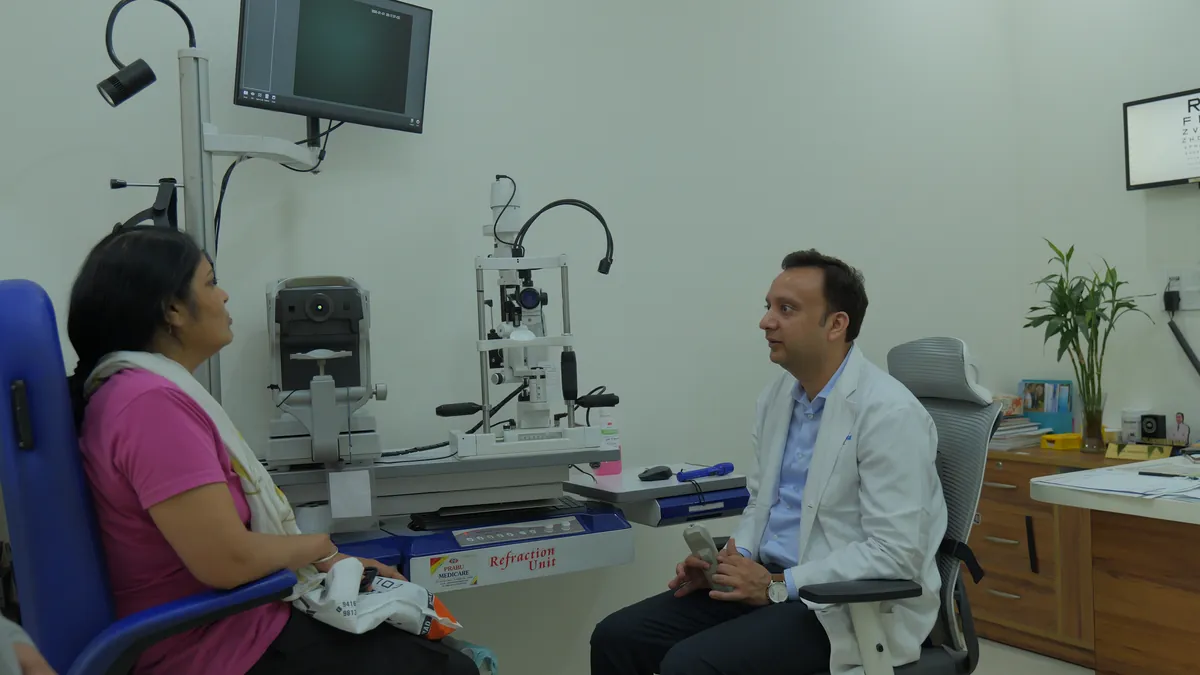
An evaluation is not a quick eye test. The machines listed at Garg Eye Hospital for refractive planning include the following.
| Test or machine | What it tells the surgeon |
|---|---|
| Auto-refractometer and chart | Your power and clearest vision |
| Pentacam | A map of the front and back of the cornea. It picks up early shape problems |
| Pachymeter | Corneal thickness |
| Tonometer | Eye pressure |
| Slit lamp | The cornea, lids, lens and tear film |
| Specular microscope | The health of the cells on the inner corneal surface |
| OCT and fundus examination | The retina and optic nerve |
| Dilated examination | The retina periphery, which matters for high power |
You are asked to stop wearing contact lenses before the corneal map. Soft lenses are usually stopped for several days to two weeks, and hard lenses for longer, as advised at your first visit. Contact lenses change the shape of the cornea, and a map taken too soon can mislead the plan.
- 1HistoryGlasses, health, medicines and what you want
- 2Vision and powerChart and auto-refractometer
- 3PressureTonometer
- 4Front of the eyeSlit lamp
- 5Corneal mapPentacam and pachymeter
- 6RetinaDilated examination
- 7PlanSurgeon explains LASIK, ICL or neither
What happens on the day of LASIK?
- You are seen by the surgeon, and numbing drops are put in.
- The femtosecond laser makes a thin corneal flap, usually in under a minute per eye.
- The flap is lifted, and the excimer laser reshapes the cornea, usually within a minute or so.
- The flap is put back, and no stitches are needed.
- You rest, are given drops and shields, and go home.
You are awake. You may feel pressure and see a bright light. The laser time is short, and the whole visit takes longer because of preparation and checks. See the full day in LASIK eye surgery in Patiala.
What happens on the day of ICL?
- The eye is numbed with drops. The pupil is kept in a suitable state.
- A tiny opening is made at the edge of the cornea.
- A foldable lens is placed inside the eye, behind the iris and in front of your natural lens.
- The lens unfolds and settles into position.
- The opening seals on its own, and you rest and go home with drops.
ICL is done one eye at a time, often on the same day or a few days apart, as the surgeon advises. See ICL surgery in Patiala for planning, lens sizing and recovery.
Is specs removal surgery painful?
Both procedures are done with numbing drops. You do not feel pain during surgery. You may feel pressure, a cool fluid or a slight tug. After LASIK, many people feel scratchy, watery or light-sensitive for a few hours. After ICL, the eye usually feels mild irritation and tends to settle quickly. Severe pain is not normal. If it happens, call the hospital.
What is the recovery timeline?
| When | LASIK | ICL |
|---|---|---|
| First few hours | Scratchiness, watering, light sensitivity | Mild irritation, blur from drops |
| Next day | Many see well. Review at the hospital | Clearer sight, review at the hospital |
| First week | Drops, no rubbing, no water in the eye | Drops, no rubbing, no heavy lifting |
| First month | Sight settles. Dryness is common and fades | Sight settles. Regular reviews |
| After 3 months | Final result in most eyes | Final result in most eyes |
Desk work often resumes in one to two days. Contact sports, swimming and heavy exercise wait as long as the surgeon advises. A review plan is given on the day, and it is important to follow it.
What are the risks and side effects?
No surgery is risk free. A good surgeon explains the risks before you decide.
| Possible issue | What to know |
|---|---|
| Dry eye | Common for weeks or months after LASIK. Usually improves with drops. ICL tends to cause less dryness |
| Glare, halos and night vision change | More common in the first weeks. Large pupils raise the risk |
| Under or over correction | A small power may remain. Glasses or an enhancement may help |
| Flap problems (LASIK) | Uncommon. Handled by the surgeon |
| Infection or inflammation | Uncommon. Drops and reviews reduce the risk |
| Raised eye pressure (ICL) | Checked at reviews and treated |
| Cataract formation (ICL) | A small long-term risk. Checked regularly |
| Regression | Power can drift in some eyes, especially if the original power was high |
Choosing the right patient is the surest way to reduce risk. A surgeon who says "not suitable yet" is protecting your eyes.
Who should not have specs removal surgery?
The surgeon may advise against surgery, or advise waiting, if any of these apply.
- Your power is still changing.
- Your corneas are thin or irregular, or show signs of keratoconus.
- You have active eye infection, uncontrolled glaucoma or advanced retinal disease.
- You are pregnant or breastfeeding. Hormonal change can shift power. Wait until after.
- You have uncontrolled diabetes or an autoimmune disease that affects healing.
- You have severe dry eye that does not improve with treatment.
- Your expectations are unrealistic, such as expecting perfect sight at every age.
If you are not suitable, ask what can change that, such as time, dry eye treatment, or a different route like ICL.
What if your cornea is thin?
A thin cornea is the most common reason people are told they cannot have LASIK. The fix may be a different route. ICL does not remove corneal tissue, so it may suit a thin cornea with high power. The surgeon reads the Pentacam map and the pachymeter thickness together, and then explains. Do not accept or reject LASIK based on a friend's story. The number you need is the one on your own map.
Can specs be removed without surgery?
This is one of the most searched questions, and the answer should be plain.
| Method | Does it remove glasses power? |
|---|---|
| Eye exercises, yoga, palming, eye drops from advertisements | No. They can relax tired eyes, but they do not change the shape or length of the eye |
| Ayurvedic, homeopathic or home remedies | No reliable proof that they remove power |
| Food, carrot juice, vitamins | They support general eye health. They do not remove power |
| Contact lenses | They replace glasses but do not remove power |
| Night lenses (orthokeratology) | They can reduce dependence on glasses for some people, but the effect fades if you stop wearing them. Ask an eye doctor if they suit you |
| Atropine drops in children | Used under a doctor to slow short sight progression in children. They do not remove power |
| Surgery (LASIK, ICL, lens-based) | Yes, for suitable eyes |
Be careful with products that promise to "remove specs in 15 days". If the claim sounds too good, it is. A healthy diet, outdoor time for children, screen breaks and regular tests help eyes, but they do not undo a power.
Chashma hatane ke gharelu upay kya sach mein kaam karte hain?
क्या चश्मा बिना ऑपरेशन के हट सकता है? आँख की कसरत, योग, घरेलू नुस्खे, आयुर्वेदिक या होम्योपैथिक दवा से चश्मे का नंबर हटने का कोई पक्का प्रमाण नहीं है। ये आँखों को आराम दे सकते हैं, पर नंबर नहीं हटाते।
चश्मा हटाने का ऑपरेशन कौन सा है? लेसिक (LASIK) और ICL दो मुख्य तरीके हैं। 45 की उम्र के बाद या मोतियाबिंद होने पर लेंस बदलने वाली सर्जरी भी विकल्प हो सकती है। कौन सा तरीका ठीक है, यह आँख की जाँच और कॉर्निया के नक्शे से तय होता है।
उम्र कितनी होनी चाहिए? आम तौर पर 18 साल से ऊपर, और नंबर लगभग एक साल से स्थिर होना चाहिए। कई सर्जन 21 साल के बाद की सलाह देते हैं।
खर्च कितना आता है? लेसिक और ICL का खर्च अलग है। अनुमान के लिए नीचे का खर्च वाला भाग देखें। अपनी आँख का सही अनुमान जाँच के बाद ही बनता है।
ऑपरेशन के बाद क्या सावधानी रखें? डॉक्टर की बताई बूँदें समय पर डालें, आँख को न रगड़ें, कुछ दिन पानी और धूल से बचाएँ और हर जाँच पर आएँ।
संपर्क करें: +91 98554-91500, सोमवार से शनिवार, सुबह 9 बजे से शाम 5 बजे तक।
How much does specs removal surgery cost in Patiala?
Prices in Patiala vary by method, lens and hospital. The planning figures below come from public listings read on 27 November 2026. They are not a price list for any one hospital, and your own cost is set after an examination.
| Option | Approximate price in Patiala |
|---|---|
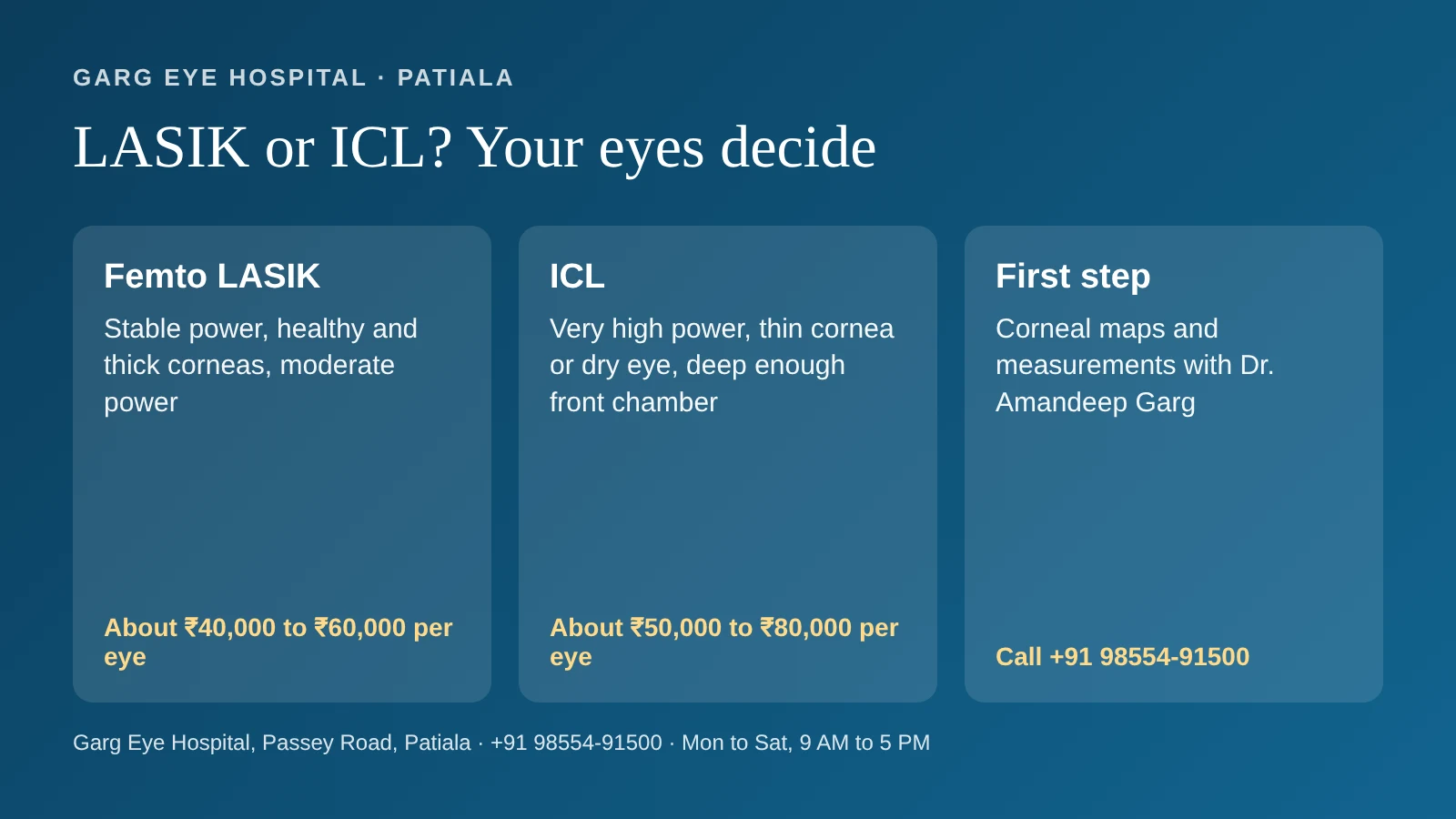
| Femto LASIK | About ₹40,000 to ₹60,000 per eye. About ₹80,000 to ₹1,20,000 for both eyes |
| ICL | About ₹50,000 to ₹80,000 per eye, depending on the lens type |
| Cataract surgery, standard lens | About ₹30,000 to ₹55,000 per eye |
| Cataract surgery, premium lens | About ₹60,000 to ₹1,10,000 per eye |
The detail is on the cost pages. See LASIK surgery cost in Patiala and ICL surgery cost in Patiala. Ask the desk for a written estimate after your examination, and ask what it includes.
Is the cost worth it?
A simple way to think about it is to count what glasses and lenses cost you over twenty years. Frames, lenses, replacements, contact lenses, solution and check-ups add up. Many people find that surgery costs less than ten to fifteen years of glasses and lens use, and it also removes daily effort. But the aim is comfort and safety, not saving money. If you are not a suitable candidate, the cheaper choice is to keep your glasses.
Will insurance pay for specs removal surgery?
Policies usually treat vision correction for power as cosmetic or elective, so cover is limited. Some policies pay a part when power is above a threshold, and some corporate plans reimburse. ICL and LASIK are commonly searched against "mediclaim". Read your policy, and ask the desk about your plan. For the broader insurance picture, see eye hospital insurance and cashless care in Patiala.
What if you want to join the army, railways or police?
Eye standards for services change with time and by branch. Some services have restrictions on refractive surgery, and others accept it with conditions. If you plan to apply for a uniformed service, check the current rules for that service and branch first, and tell the surgeon your plan before you decide. A surgery done too early can affect eligibility in some cases.
Specs removal surgery in Patiala: what people here ask and what the answer is
People in Patiala search this topic in a few repeating ways: specs removal surgery in Patiala, LASIK in Patiala, LASIK surgeon in Patiala, LASIK cost in Patiala, and whether insurance pays for it. Each has a direct answer below and in the questions at the end of the page.
LASIK surgeon in Patiala
Dr. Amandeep Garg, MBBS, DNB, performs LASIK at Garg Eye Hospital, Passey Road, Patiala. He is the only surgeon at the hospital, so the doctor who reads your corneal maps is the doctor who operates.
LASIK centre and laser room in Patiala
The hospital has a femtosecond laser and an excimer laser, and the corneal checks are done with Pentacam, a pachymeter and an auto-refractometer. The laser suite is inside the hospital on Passey Road.
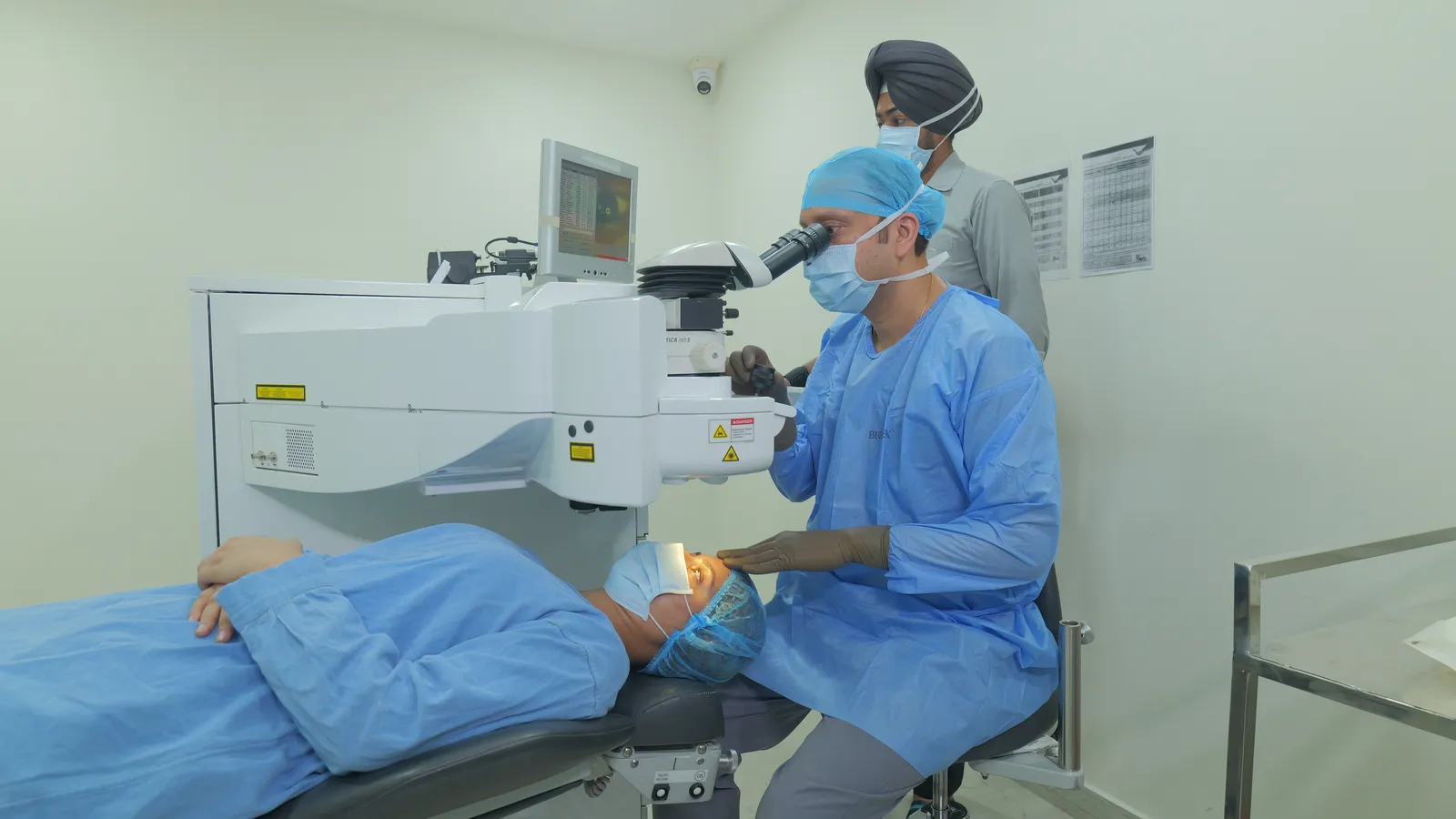
Specs removal surgery in Patiala: appointment and contact number
Call +91 98554-91500, Monday to Saturday, 9 AM to 5 PM, or use the booking page. The first visit is an examination. Surgery is planned only after your tests are read.
Specs removal surgery in Patiala: reviews
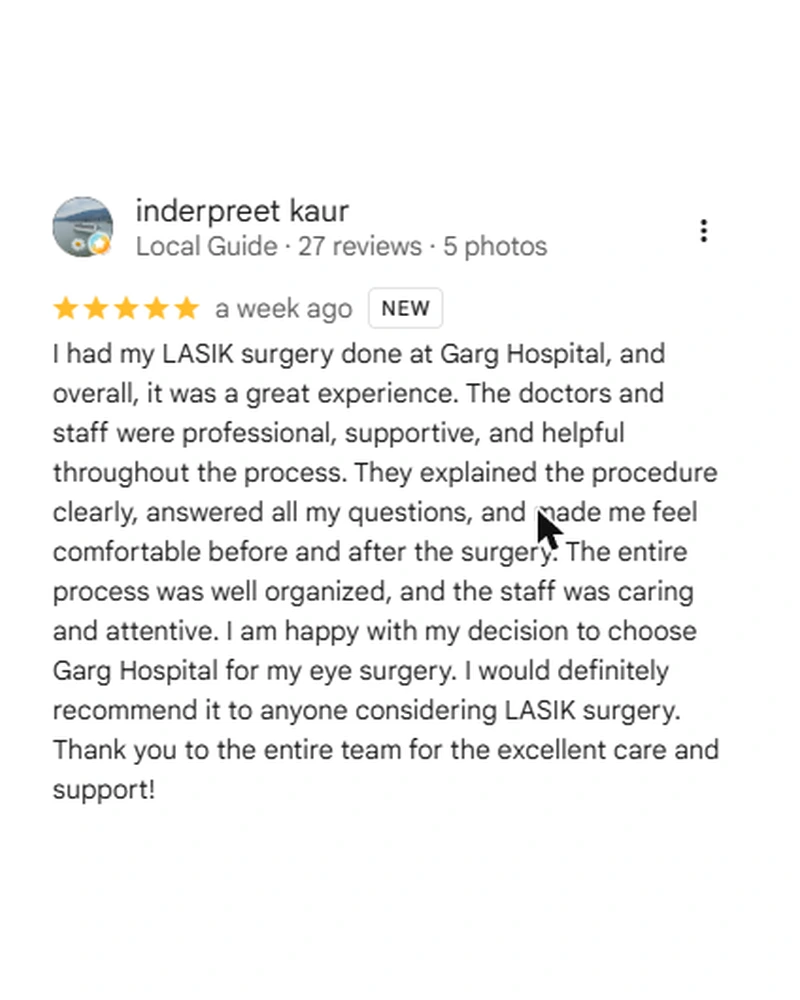
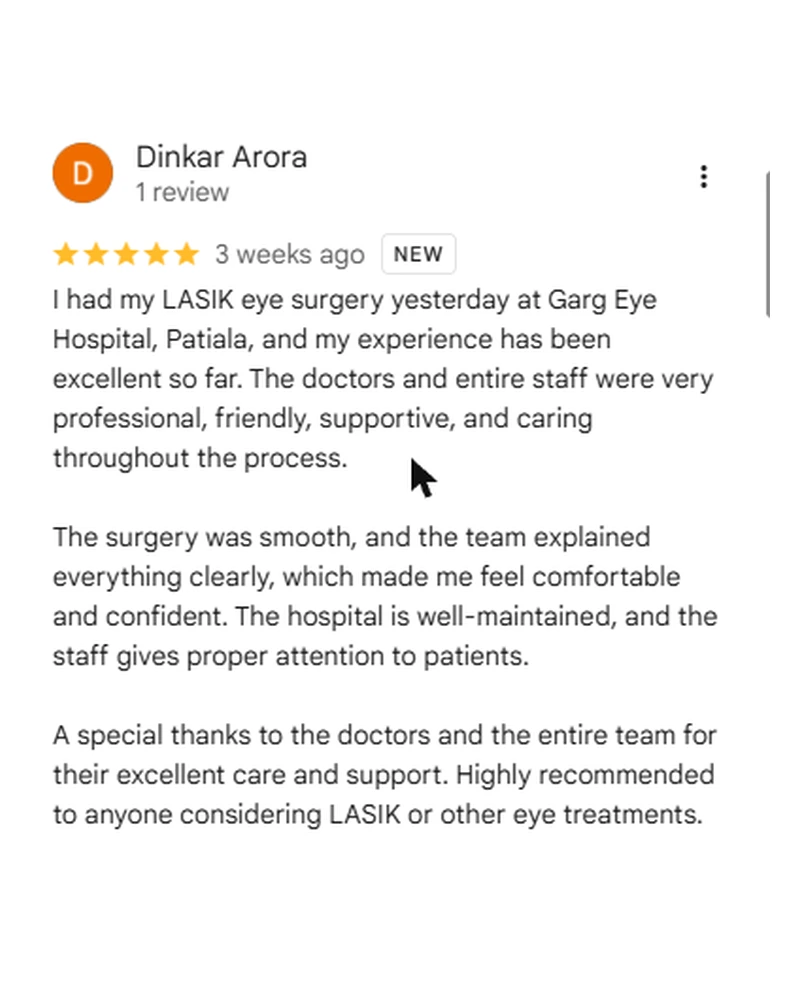
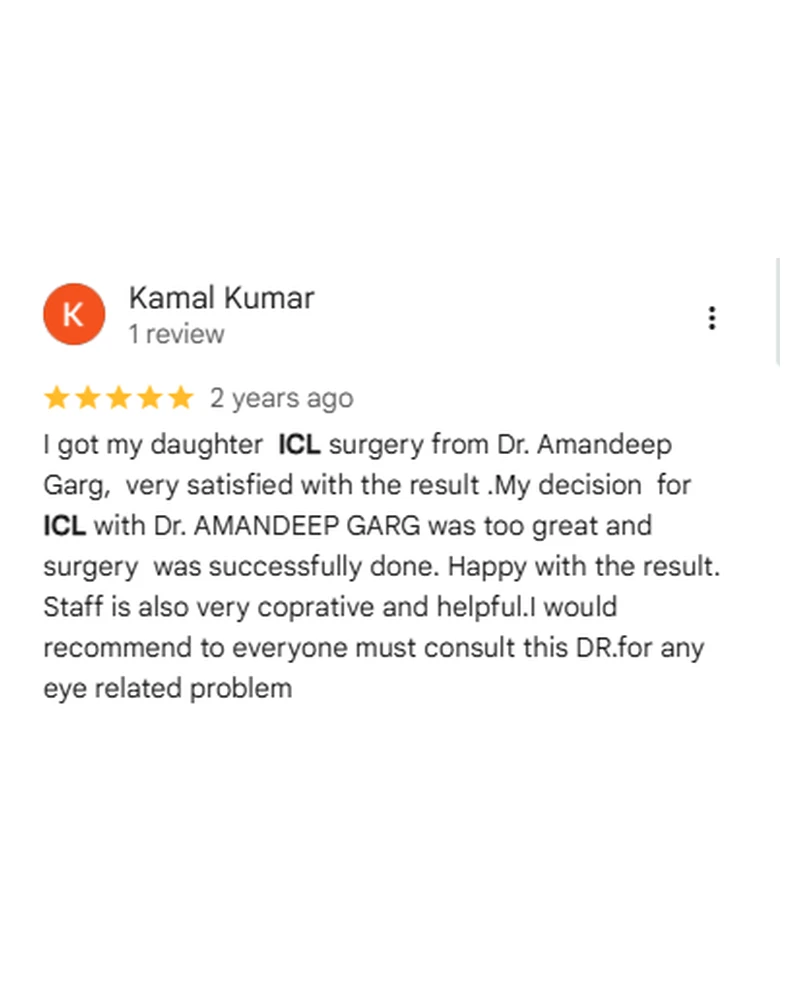
Patients write about LASIK and ICL at this hospital on Google. Screenshots are shown further down this page, with the rating read on 27 November 2026.
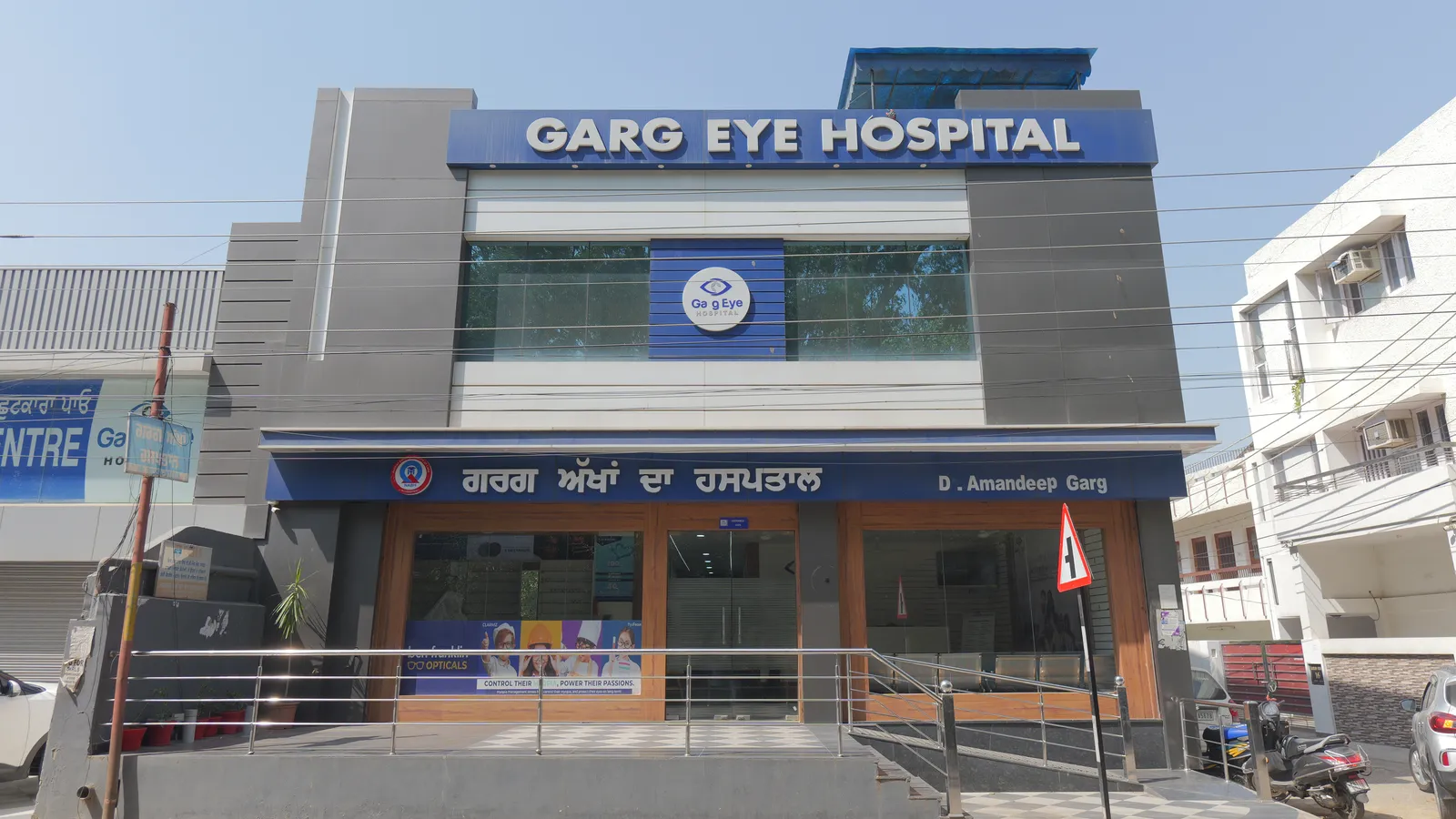
Garg Eye Hospital on Passey Road, Patiala: how to reach us for specs removal surgery
Garg Eye Hospital is on Passey Road, Patiala, Punjab 147001, near Gurudwara Dukh Niwaran Sahib. On Google Maps the pin sits close to the Sikh Museum, on the Passey Road and Sirhind Road side of the city. Ask for Garg Eye Hospital near Dukhniwaran Sahib and anyone nearby can point you to it.
Coming from the bus stand, Leela Bhawan, Urban Estate, Tripuri, Bhadson Road or SST Nagar
Open the hospital pin on Google Maps and follow the route, or call +91 98554-91500 and the desk will guide you. OPD runs Monday to Saturday, 9 AM to 5 PM. Mornings are quieter, so a visit that starts at 9 or 10 AM usually finishes sooner.
Coming from Punjabi University, Thapar University or the Sheran Wala Gate side
Students and staff from this side of Patiala usually come between classes. Tell the desk your timetable when you book and the visit can be planned around it.
Coming from Nabha, Rajpura, Samana, Sirhind-Fatehgarh Sahib, Sangrur, Malerkotla or Khanna
Patients travel from these towns for eye care. See the pages for Nabha, Rajpura, Samana, Sirhind, Sangrur, Malerkotla and Khanna. Bring one family member, because eye drops can blur vision for a few hours after tests.
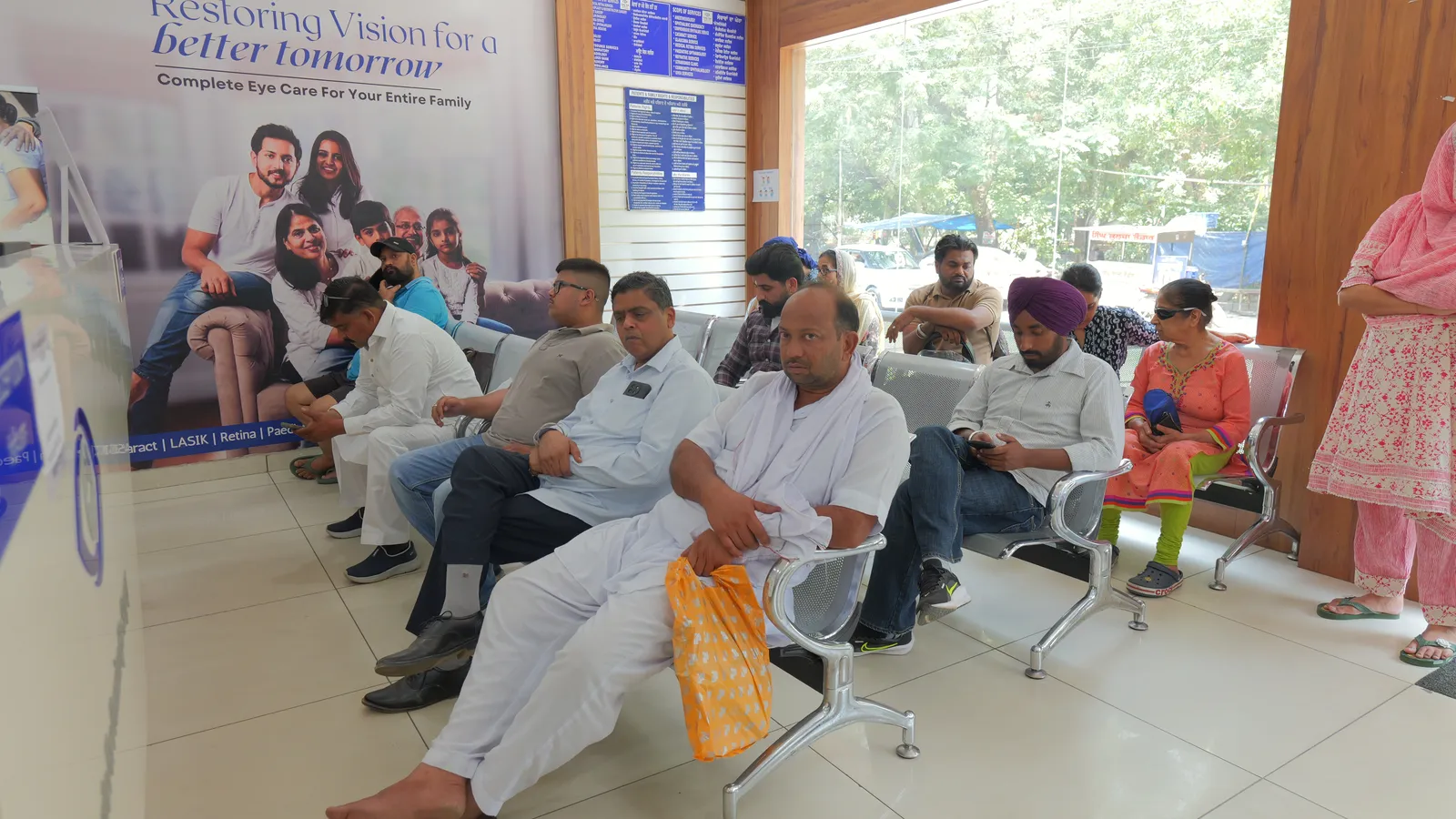
What patients wrote on Google about Garg Eye Hospital, Patiala
The Google listing of Garg Eye Hospital, Patiala, shows a 5.0 rating from 1,597 reviews (1,566 five star, read on 27 November 2026). These are screenshots of public reviews, shown as they appear.
Frequently asked questions about specs removal surgery in Patiala
Specs removal surgery in Patiala: which hospital does it?
Garg Eye Hospital, Passey Road, near Gurudwara Dukh Niwaran Sahib, Patiala, offers Femto LASIK and ICL for specs removal. Dr. Amandeep Garg, MBBS, DNB, plans and performs every case.
What is the cost of specs removal surgery in Patiala?
Public listings read on 27 November 2026 show Femto LASIK at about ₹40,000 to ₹60,000 per eye and ICL at about ₹50,000 to ₹80,000 per eye in Patiala. These are market ranges, not hospital prices. Your own cost is set after the examination.
LASIK eye surgery cost in Patiala: for one eye or both?
Listings usually quote per eye. For both eyes the planning range is about ₹80,000 to ₹1,20,000 for Femto LASIK. Ask the desk what the estimate includes, such as tests, medicines and follow-up visits.
Is LASIK available in Patiala?
Yes. Garg Eye Hospital on Passey Road has a femtosecond laser and an excimer laser, and Dr. Garg performs LASIK there.
Who is the LASIK surgeon in Patiala at Garg Eye Hospital?
Dr. Amandeep Garg, MBBS, DNB, a phaco and LASIK surgeon. He is the only surgeon at the hospital.
How do I book specs removal surgery in Patiala?
Call +91 98554-91500 or use the booking page. You first have an examination with corneal tests. Surgery is planned after that, not on the first call.
What is the contact number for specs removal surgery in Patiala?
+91 98554-91500. The OPD runs Monday to Saturday, 9 AM to 5 PM. The email is gargeyehosp@gmail.com.
Does insurance cover LASIK eye surgery?
Most policies treat LASIK as elective vision correction, so cover is limited. Some policies pay a part when the power is above a set level, and some company plans reimburse. Read your policy and bring it to the desk.
Which insurance companies cover LASIK in India?
It depends on the policy, not only on the company. Check the clause on refractive error or vision correction in your own policy. The hospital works with insurers, TPAs and government schemes for treatments that are covered.
What is the age limit for LASIK?
Your power should be stable, usually for about a year, and most patients are adults from 18 years. The upper range depends on your eyes. After the mid forties, reading glasses and cataract planning enter the discussion, and the doctor explains them.
How long is the recovery after LASIK?
Many patients see well within a day and return to routine work in a few days. Dryness and glare can last longer. Follow the drop schedule and the review visits.
What are the side effects of LASIK?
Dry eye, glare or halos at night, and under or over correction are the common ones. Rare problems exist, which is why the tests before surgery matter. The doctor explains your own risks.
Can I do LASIK if my cornea is thin?
Not always. A pachymeter and Pentacam measure thickness and shape. If the cornea cannot spare tissue, ICL may be the safer route.
LASIK or ICL: which is better for high power?
Very high power often points toward ICL, because no corneal tissue is removed. Moderate power with healthy, thick corneas often suits LASIK. Your tests decide, not preference.
Can I remove specs without surgery?
Contact lenses are an alternative to glasses. Eye exercises and home remedies do not remove power from the eye. Only a procedure changes it.
Chashma hatane ka operation kitne ka hota hai Patiala mein?
Patiala ke public listings mein Femto LASIK lagbhag ₹40,000 se ₹60,000 per eye aur ICL ₹50,000 se ₹80,000 per eye dikhta hai. Yeh market range hai, hospital ka rate nahi. Pakki keemat jaanch ke baad batayi jaati hai. Call: +91 98554-91500.
Contact Garg Eye Hospital, Patiala
Passey Road, Near Gurudwara Dukh Niwaran Sahib, Patiala, Punjab 147001
Phone: +91 98554-91500
Email: gargeyehosp@gmail.com
OPD: Monday to Saturday, 9 AM to 5 PM
Open the map