Deciding on the best vision correction procedure is a big step. With options like LASIK and ICL, many people want to know which is safer, more effective, and right for their eyes.
If you are considering LASIK eye surgery in Punjab, you might be comparing these choices to see which gives the best long-term results.
This guide explains both LASIK and ICL with expert advice to help you make an informed decision.
What Is LASIK?
LASIK, which stands for Laser-Assisted In-Situ Keratomileusis, is a common laser eye surgery that changes the shape of the cornea to fix vision problems like nearsightedness, farsightedness, and astigmatism.
This quick and effective procedure works best for people whose eye prescription is stable and who have enough corneal thickness.
How LASIK Works
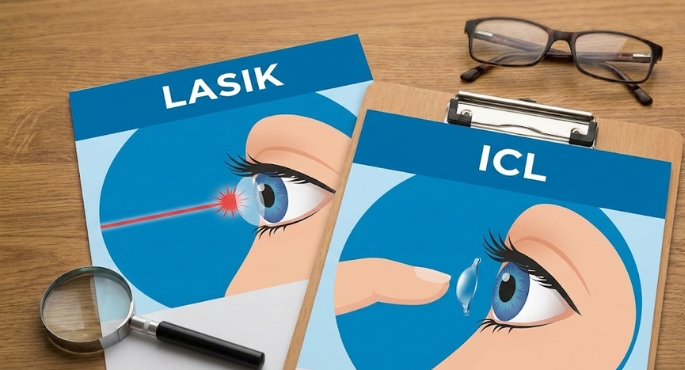
- A surgeon makes a thin flap on the surface of your cornea
- Next, a laser reshapes the layer underneath your cornea
- The surgeon puts the flap back in place so your eye can heal quickly on its own
LASIK is known for its accuracy, minimal discomfort, and quick recovery.
What Is ICL?
ICL (Implantable Collamer Lens) is a procedure where a soft, biocompatible lens is placed inside your eye, just behind the iris. Unlike LASIK, it does not change the shape of your cornea, making it a good option for people who are not candidates for laser treatments.
How ICL Works
- A small incision is made.
- A soft, foldable lens is gently placed inside the eye.
- The lens rests behind the iris and works like a permanent contact lens inside the eye.
ICL provides a clear vision and is often chosen for people with strong prescriptions or thin corneas.
LASIK vs ICL: Key Differences
1. Technique
- LASIK uses a laser to reshape the cornea.
- ICL involves placing a corrective lens inside the eye.
2. Reversibility
- LASIK makes permanent changes to the cornea.
- ICL is reversible because the lens can be removed or replaced.
3. Suitability
- LASIK works best for people with sufficient corneal thickness and stable vision prescriptions.
- ICL is a good option for those with thin corneas, severe nearsightedness, or very high prescriptions.
4. Dry Eye Risk
- LASIK can sometimes cause temporary dryness in the eyes.
- ICL does not affect the corneal nerves, so it usually does not cause dryness.
5. Recovery
- With LASIK, most people recover quickly, often feeling back to normal in just 24 hours.
- ICL recovery usually takes a little longer and often requires a few more follow-up visits.
Pros and Cons of LASIK
Pros
- LASIK offers quick and accurate vision correction, giving most people clear vision in about 24 hours with little discomfort.
- Most people can get back to their usual activities within a day or two after LASIK.
- If your cornea is suitable, LASIK results usually stay stable for many years.
- LASIK is effective for people with mild to moderate vision problems and can correct a wide range of prescriptions.
Cons
- This procedure is not recommended for people with thin or irregular corneas, as it needs enough healthy corneal tissue.
- Some patients may notice temporary eye dryness during healing.
- This procedure cannot be reversed because it permanently removes some corneal tissue.
Pros and Cons of ICL
Pros
- Helps people with very high refractive errors by correcting vision levels that LASIK cannot fix.
- Safe for people with thin or irregular corneas because it does not require tissue removal, making it an option for more patients.
- This procedure is reversible and can be updated, since the lens can be replaced in the future if needed.
- It does not cause dry eye problems because the cornea is left untouched.
- The collamer lens also provides UV protection by naturally filtering out harmful rays.
Cons
- It costs more than LASIK because the lens and the procedure are more specialized.
- This option requires minor surgery, in which a lens is placed inside the eye. The procedure is considered safe.
- You will need regular check-ups to make sure the lens stays in the right place.
Which Option Is Better for You?
Choosing between LASIK and ICL depends on multiple factors:
- Corneal thickness
- Eye power
- Age
- Lifestyle requirements
- Overall eye health
You may be a good candidate for LASIK if:
- Your cornea is healthy and has good thickness.
- Your prescription is within the range that LASIK can safely correct.
- You would like a quick procedure that does not require surgery.
You may be better suited for ICL if:
- You have a strong or severe refractive error in your vision
- Your cornea is too thin or not suitable for LASIK surgery
- You prefer a treatment that can be reversed if needed
- You often have dry eyes that do not go away
A thorough eye exam helps us find the safest and best procedure for you.
FAQs
1. Is LASIK or ICL safer?
Both options are safe when chosen for the right clinical reasons. The best choice depends on your eye structure and the type of vision problem.
2. Which procedure is best for high eye power?
ICL is often chosen for people with very high refractive errors, especially when LASIK is not an option.
3. Does ICL stay permanently inside the eye?
Yes, ICL is meant to stay in place for a long time, but it can be taken out or changed if needed.
4. How long does recovery take?
Most people recover from LASIK in 24-48 hours. ICL recovery can take a few days and usually involves follow-up visits.